
Calibration of test weights

In order to have calibrated measuring devices you must have calibrated checking equipment. For balances, for example, the test equipment is calibrated test weights.
Depending on frequency of use, test weights must be recalibrated at regular intervals. This is the only way to guarantee that you maintain the requirements for checking equipment so that it functions reliably.
Recalibration times depend on the frequency of use, the conditions of use and your safety requirements.
The standard does not give a defined recalibration period. We recommend that, with intensive use, you recalibrate your test weights every 6 months and with normal use, every 12 months.
KERN calibrates test weights
- in all OIML error limit classes E1 - M3 and in sizes 1 mg - 500 kg.
- Test weights with free nominal value (any weight value)
- Carried out in Newton
- Independent of design (special designs)
- Independent of the brand
The advantages of using KERN on-site calibration (we visit you)
We would be pleased to visit you within Germany and calibrate your test weights to OIML error limits M1 - M3, 10 kg - 50 kg with our mobile MACOS calibration system. Minimized downtime of your checking equipment and direct contact with our expert are the major benefits of this service. Prices on request.
The advantages of using KERN in-house calibration (you send your test weights to us)
- Excellent price to performance ratio
-
Quick handling time
- DKD standard: 4 working days
- DKD Express Service: 48 hours (for new weights)
- Calibration service independent of the brand
- KERN also reconditions old customer weights (e.g. cleaning or readjustment)
- KERN DKD calibration certificates are valid international
- We would be pleased to monitor your recalibration times
- On request, collection and delivery service by our courier service
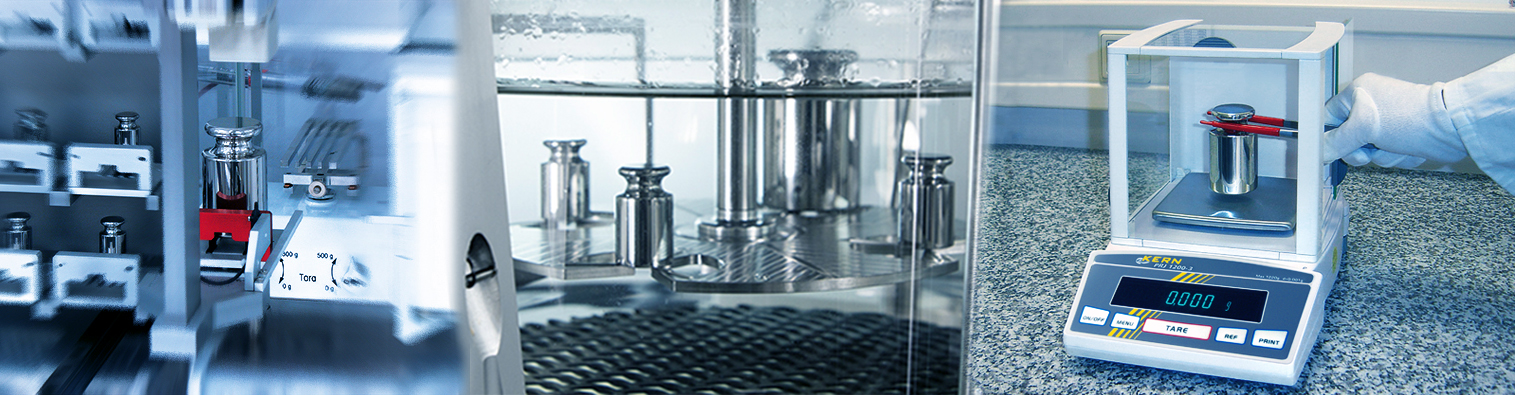
- The most modern calibration methods with robot operated comparators allow the most accurate calibration results and rapid process times


What is OIML?
OIML (Organisation Internationale de Métrologie Légale) has representatives from almost 100 states who work on unified build and test regulations for all measuring devices. In the OIML certification system the certificates issued by the member states certify that a particular measuring device build type is in accordance with the OIML recommendations. In this way, a build type which was tested and approved in one country, can be approved in another country without having to repeat the test. (Excerpt from PTB)

The OIML R111 guideline defines the construction-related characteristics for test weights, such as material, upper surface texture, markings, construction, shape etc.
Error limits according to OIML R111 for test weights
| Error limit class (tolerance ±) | |||||||
|---|---|---|---|---|---|---|---|
| E1 | E2 | F1 | F2 | M1 | M2 | M3 | |
|
Nom.- value |
|||||||
| 1 mg | ±0.003mg | ±0.006mg | ±0.020mg | ±0.06mg | ±0.20mg | ||
| 2 mg | ±0.003mg | ±0.006mg | ±0.020mg | ±0.06mg | ±0.20mg | ||
| 5 mg | ±0.003mg | ±0.006mg | ±0.020mg | ±0.06mg | ±0.02mg | ||
| 10 mg | ±0.003mg | ±0.008mg | ±0.025mg | ±0.08mg | ±0.25mg | ||
| 20 mg | ±0.003mg | ±0.010mg | ±0.03mg | ±0.10mg | ±0.3mg | ||
| 50 mg | ±0.004mg | ±0.012mg | ±0.04mg | ±0.12mg | ±0.4mg | ||
| 100 mg | ±0.005mg | ±0.016mg | ±0.05mg | ±0.16mg | ±0.5mg | ±1.6mg | |
| 200 mg | ±0.006mg | ±0.020mg | ±0.06mg | ±0.20mg | ±0.6mg | ±2.0mg | |
| 500 mg | ±0.008mg | ±0.025mg | ±0.08mg | ±0.25mg | ±0.8mg | ±2.5mg | |
| 1 g | ±0.010mg | ±0.03mg | ±0.10mg | ±0.3mg | ±1.0mg | ±3.0mg | ±10mg |
| 2 g | ±0.012mg | ±0.04mg | ±0.12mg | ±0.4mg | ±1.2mg | ±4.0mg | ±12mg |
| 5 g | ±0.016mg | ±0.05mg | ±0.16mg | ±0.5mg | ±1.6mg | ±5.0mg | ±16mg |
| 10 g | ±0.020mg | ±0.06mg | ±0.20mg | ±0.6mg | ±2.0mg | ±6.0mg | ±20mg |
| 20 g | ±0.025mg | ±0.08mg | ±0.25mg | ±0.8mg | ±2.5mg | ±8.0mg | ±25mg |
| 50 g | ±0.03mg | ±0.10mg | ±0.3mg | ±1.0mg | ±3.0mg | ±10mg | ±30mg |
| 100 g | ±0.05mg | ±0.16mg | ±0.5mg | ±1.6mg | ±5.0mg | ±16mg | ±50mg |
| 200 g | ±0.10 mg | ±0.3mg | ±1.0mg | ±3.0mg | ±10mg | ±30mg | ±100mg |
| 500 g | ±0.25mg | ±0.8mg | ±2.5mg | ±8.0mg | ±25mg | ±80mg | ±250mg |
| 1 kg | ±0.5mg | ±1.6mg | ±5.0mg | ±16mg | ±50mg | ±160mg | ±500mg |
| 2 kg | ±1.0mg | ±3.0mg | ±10mg | ±30mg | ±100mg | ±300mg | ±1,0g |
| 5 kg | ±2.5mg | ±8.0mg | ±25mg | ±80mg | ±250mg | ±800mg | ±2,5g |
| 10 kg | ±5.0mg | ±16mg | ±50mg | ±160mg | ±500mg | ±1600mg | ±5,0g |
| 20 kg | ±10mg | ±30mg | ±100mg | ±300mg | ±1000mg | ±3000mg | ±10g |
| 50 kg | ±25mg | ±80mg | ±250mg | ±800mg | ±2500mg | ±8000mg | ±25g |
| 100 kg | ±160mg | ±500mg | ±1600mg | ±5000mg | ±16g | ±50g | |
| 200 kg | ±300mg | ±1000mg | ±3000mg | ±10g | ±30g | ±100g | |
| 500 kg | ±800mg | ±2500mg | ±8000mg | ±25g | ±80g | ±250g | |
| 1000 kg | ±1600mg | ±5000mg | ±16g | ±50g | ±160g | ±500g | |
| 2000 kg | ±10g | ±30g | ±100g | ±300g | ±1000g | ||
| 5000 kg | ±25g | ±80g | ±250g | ±800g | ±2500g | ||
Selection of the appropriate test weight

Quality of the test weight:
A balance can never be more accurate than the test weight which is used to adjust it. It depends on its tolerances.
Accuracy of the test weight:
Must approximately correspond to the readout d of the balance, or should if anything, be better.
Weight size:
This is often shown in the adjust mode “CAL” in the balance display. Given a choice, the largest displayed weight is the best one to use for accurate measurement. The weight of your test weight should ideally be larger than 80% of the maximum weighing range of the balance. If accuracy and weight size (nominal value) are fixed, the appropriate test weight is selected according to the tolerances of the individual accuracy classes (error limit classes) E1 to M3 (see table above).
Example:
Balance with weighing range Max 2000 g (2 kg) and readout d 0.01 g (10 mg)
- The accuracy of the required test weight is determined by the readout d with approx. ±10 mg.
- Displayed weight size in mode "CAL": 1000 g or 2000 g. The required test weight therefore has the weight size 2 kg.
- Appropriate test weight with tolerance ±10 mg and weight size 2 kg is found in error limit class F1.
Exception analytical balances (readout d ≤ 0.1 mg):
E1 test weights are recommended. Depending on the safety requirement, E2 test weights with a DKD calibration certificate will also be sufficient.