
Kern & Sohn GmbH - Balances and Weights de | en | fr |  
GTC | Contact |
  KERN Calibration Laboratory (DKD, ISO)    
 
Services
Company

Force, hardness, thickness of layers ...  

Factory calibration certificates (ISO calibration):

Force-measuring devices

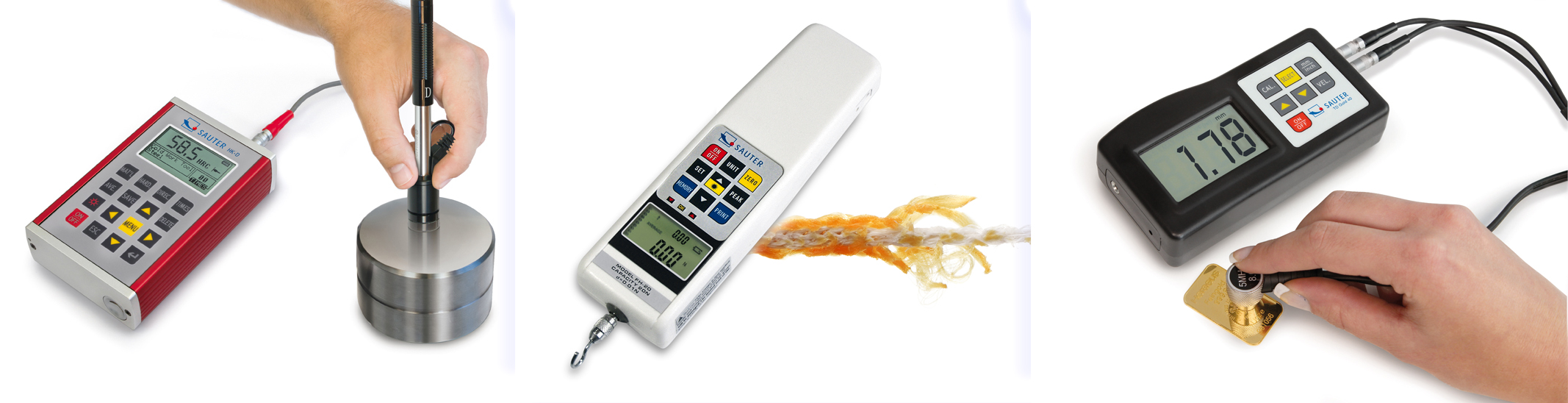
As DKD calibration certificates cannot be offered for all measuring devices or measurement sizes, or where it is not customary, we then offer factory calibration certificates. These ISO calibration certificates meet international standards and are particularly suitable as proof of exacting calibration in the monitoring of your checking equipment. ISO calibrations are available for many measuring devices, for example

  • Mechanical balances (spring balances, etc.)
  • Force-measuring devices up to 14.5 kN bis 14,5 KN
  • Measuring devices for layer thickness 0 μm – 2000 μm
  • Hardness testing devices in accordance with Leeb test
  • Ultrasound material thickness testing devices 25 – 300 mm

We carry out calibrations whatever the brand. In order to avoid any unnecessary delays when processing your order, please send us the technical documents and accessories with the checking device.
Calibration time 4 working days.

For up-to-date information on test services for further measuring sizes please visit our website www.kern-sohn.com www.kern-sohn.com

Prices for initial calibration and recalibration

Checking equipment DKD / ISO KERN Price in €
excl. of VAT ex works
Force-measuring devices bis 500 N ISO 961-161R 135,-
Force-measuring devices bis 2 KN ISO 961-162R  165,-
Force-measuring devices bis 10 KN ISO  961-163R 225,-
Force-measuring devices bis 14,5 KN ISO  961-164R 350,-
Hardness testing device in accordance
with Leeb testing (type D)
ISO 961-131R 120,-
Measng. dev. for layer thickness 0 µm - 2000 µm
(ferrous or nonferrous)
ISO 961-110R  120,- 
Measng. dev. for layer thickness 0 µm - 2000 µm
(ferrous or nonferrous)
ISO 961-112R 170,-
Ultrasonic material thickness testing device
25 mm - 300 mm
ISO 961-113R 120,-
Mechanical balances (spring balances, …)
Max . load 5 kg
ISO 961-113R 65,-
Mechanical balances Max. load > 5kg-50kg ISO 961-101R 80,-
Mechanical balances Max. load > 50kg-350kg ISO 961-102R 95,-
Mechanical balances Max. load>
350 kg - 1500 kg
ISO 961-102R 150,-

All you need to know about calibration

  DKD-calibration Verification (area regulated by law)
 Why? DKD calibration is always necessary when checking equipment (balance or test weight) is to be used in a QM process
(e.g. to ISO 9000ff , GS 9000, TS 16949, VDA 6.1, FDA, GLP, GMP, ...)
Applications with mandatory verification of balances and test weights include:
  • in commercial trade when the price of a commodity is determined by weighing
  • the manufacture of pharmaceuticals in pharmacies
  • the production of pre-packaged goods
  • in medical applications
 What? Any checking equipment in proper condition can be DKD calibrated You can only verify balances which have official buildtype approval and test weights which conform to OIML standards
 
How
?

Determination of accuracy throughout the world by a laboratory which is accredited to DIN EN ISO/IEC 17025
Traceability to internationally recognised standards
The DKD calibration certificate confirms both the metrological characteristics of the checking equipment
and the general requirements for the monitoring of checking equipment


Testing to verification error limits. National regulations apply
 Where? Internationally recognised
This is monitored by ILAC (International Laboratory Accreditation Cooperation) and in Germany, for example the DAkkS (Deutsche AkkreditierungsStelle GmbH) (German accreditation point)
 Nationally recognised
 When? The operator controls the use of checking equipment and periodic recalibration time intervals themselves The legislative body governs the use of balances and test weights as well as time intervals for re-verification

Calibrating

Calibration is determining the relationship between the value of a measuring device (measuring appliance/material measure/value of a reference material) and the values established by precise test weights.
The calibration certificate contains the measured value with information on the relevant measuring uncertainty. If applicable, a statement can be made as to whether this is within tolerance limits. Industry requires calibration of measuring devices, in order to, for example, be able to connect parts manufactured at different locations without encountering problems.
Calibrations must be repeated at appropriate time intervals. The length of this time span depends on a range of variables, e.g. frequency of use, type of use, long-term stability, environmental conditions, safety requirements.

DKD calibration

DKD calibration is carried out for measuring devices, reference materials and material measures for particular measurement sizes and measurement ranges, which are defined individually for every laboratory as part of their accreditation. The issued DKD calibration certificates are proof of the metrological traceability to national and international standards, as required, for example, by the DIN EN ISO 9000 and DIN EN ISO/IEC 17025 standards. DKD calibration has no legally regulated period of validity. The operator is responsible for observing an appropriate time for recalibration. Usually the recalibration period is approx. 1 year.

International validity

DAkkS is represented in the EA (European co-operation for accreditation). This ensures that DKD calibration and DKD calibration certifi cates are recognised and valid almost anywhere in the world.

Adjusting

Precise setting of a measured value by professional intervention in the measurement system. For balances: Either with an external test weight using the adjustment function (CAL or CAL key), or with the automatic internal adjustment or adjustment control. This is necessary following changes in temperature, changed environmental conditions, change of location, etc. daily routine checks are recommended. The term “calibrating” was formerly also used for adjusting.

Traceability

This is the process of relating measuring results to national standards and thereby to the appropriate SI unit through a continuous hierarchical chain of calibrations. The most important standards demand that all checking equipment (e.g. test weights) meets the national or international standards in accordance with defined tolerances. In weighing technology, these standards are the test weights. They are traced back to the national test weight in the PTB (Physikalisch Technische Bundesanstalt) in Braunschweig, which in turn is derived from the original kilogram in Paris. In this way, incorrect measurements through inaccurate checking equipment is avoided.

Measuring uncertainty

The measuring uncertainty of a measuring device is an objective measure of its accuracy and is therefore an accurate statement for its appropriate use. It is easy to establish, with confidence, the suitability of a measuring device for a particular process if you know the measuring uncertainty. Selecting the correct measuring device saves cost, as having a measuring accuracy which is too high can be unnecessarily expensive.


Prices for calibration of force gauges

You can find our Price list for calibration and recalibration of force-measuring devices here.


Copyright © 2009-2012 KERN & Sohn GmbH